


Heat stress is becoming a central challenge in plant science, crop development, and agricultural production. As heatwaves become more frequent and intense. researchers are increasingly asking not only whether a plant can survive high temperatures. but how it manages heat physiologically, and at what cost.
One of the most important cooling mechanisms in plants is transpiration. By moving water from the roots through the plant and releasing it as vapor through the stomata. plants can reduce leaf and canopy temperature through evaporative cooling. But this process is not simple. Cooling depends on water availability, stomatal regulation, vapor pressure deficit, radiation, canopy structure, and the plant’s ability to maintain physiological activity under stress. For researchers, the key question is therefore not only “does the plant transpire?”, but how transpiration, cooling, and water use are connected over time. Below, we answer some of the most common questions about plant cooling, transpiration, heat and how these processes can be measured.
How do plants cool themselves during heat stress?
Plants cool themselves mainly through transpiration.
When stomata are open, water vapor exits the leaf into the surrounding air. This evaporation requires energy, and part of that energy comes from heat in the leaf. As a result, transpiring leaves can become cooler than they would be without water loss.
This is the same physical principle behind evaporative cooling, but in plants it is controlled biologically through stomatal behaviour, water transport, root water uptake, and environmental conditions.
A study by Urban et al. (2017) showed that evaporative cooling in well-watered poplar reduced leaf temperature by up to 9°C. However, under drought conditions, the cooling effect was much smaller. This highlights an important point: transpiration can cool the plant, but only when the plant has enough water and hydraulic capacity to support that process.
Why is transpiration important under high temperature?
Under heat stress, transpiration serves two connected roles.
First, it helps regulate leaf and canopy temperature. A plant that can maintain transpiration under hot conditions may reduce thermal damage and continue physiological activity for longer.
Second, transpiration reflects how the plant is managing water. When water is available, stomata may remain open and allow cooling. When water becomes limited, stomata often close to prevent water loss, but this also reduces evaporative cooling and can increase leaf temperature.
This creates a physiological trade-off: keeping stomata open may help cooling and carbon gain, but increases water loss. Closing stomata conserves water, but may increase heat load and limit photosynthesis.
For this reason, transpiration is not just a water-use trait. It is also closely linked to heat response, stress timing, and plant performance under dynamic environmental conditions.
Does higher transpiration always mean better heat tolerance?
Not necessarily.
A plant with high transpiration may cool itself effectively, but it may also use water rapidly. Under limited water supply, this can lead to faster soil water depletion and earlier stress onset.
On the other hand, a plant with lower transpiration may conserve water, but it may also have less evaporative cooling during heat events.

The more informative question is not simply which plant transpires more. It is which plant maintains an effective balance between water use, cooling, growth, and stress response under the specific conditions of the experiment.
This is why continuous measurements are important in heat studies. Plant cooling is dynamic: as temperature, radiation, and VPD change throughout the day, the relationship between transpiration and canopy temperature can also shift. A single measurement may capture one point in time, but miss the timing, intensity, and duration of the cooling response.
Measure both transpiration and canopy temperature?
Transpiration and canopy temperature provide two different but connected views of plant response.
Transpiration shows how much water the plant is losing over time and how actively it is exchanging water with the environment.
Canopy temperature shows how the plant’s surface temperature responds under the combined influence of radiation, air temperature, VPD, water status, and stomatal regulation.
When measured together, these variables can help researchers evaluate whether water loss is translating into effective cooling, and whether differences between plants are physiological, environmental, or related to experimental treatment.
For example, two plants may show similar canopy temperatures but different transpiration rates, suggesting different water-use strategies. Alternatively, two plants may transpire at different rates but maintain similar cooling, which may indicate differences in canopy structure, stomatal regulation, or hydraulic behaviour.
The relationship between transpiration and canopy temperature is therefore not only descriptive. It can help researchers interpret the plant’s response to heat in a more physiologically meaningful way.
Why is continuous measurement important?
Heat stress is highly dynamic. Temperature, radiation, humidity, and VPD change throughout the day, and plant responses change with them.
A plant may maintain high transpiration in the morning, reduce stomatal conductance at midday, partially recover in the afternoon, and behave differently again on the following day as the temperature changes. These patterns are difficult to capture with isolated measurements.
Continuous monitoring and personalization allow researchers to follow the entire daily response curve. It can show when stress begins, how rapidly the plant responds, whether the response is reversible, and how different genotypes or treatments behave under the same environmental conditions.
How does PlantArray measure plant cooling responses?
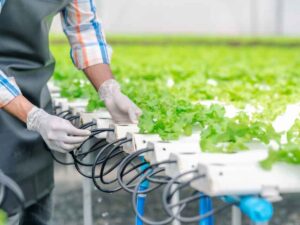
PlantArray, developed by Plant-Ditech, is a high-throughput physiological phenotyping platform designed to monitor whole-plant water relations and growth dynamics in real time.
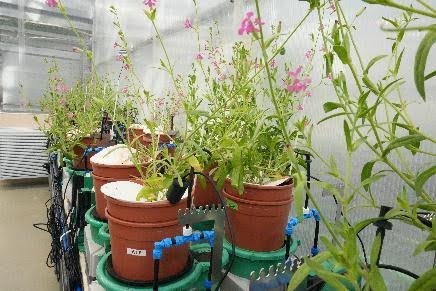
Using gravimetric measurements, PlantArray continuously tracks changes in plant weight, allowing researchers to calculate whole-plant transpiration, biomass gain, water-use efficiency, and related physiological traits. Environmental data can be collected simultaneously, allowing plant responses to be interpreted in relation to changing conditions such as temperature, humidity, and VPD. In heat-related experiments, the data that has been provided can be used together with infrared-based canopy temperature measurements to examine the relationship between transpiration and plant cooling. This makes it possible to follow how plants regulate water loss and temperature throughout the day, across treatments, and across many plants.
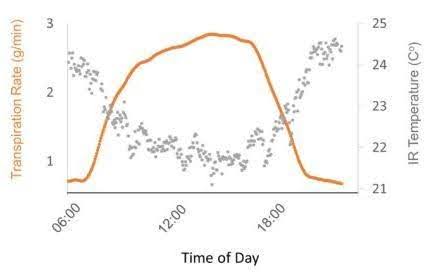
Fig 3: The following graph follows the plant continuously throughout the day, showing whole-plant transpiration rate together with infrared-based canopy temperature. Rather than relying only on endpoint observations or visible symptoms, dynamic measurements allow researchers to follow the physiological response as it develops. This makes it possible to examine not only whether a plant was exposed to heat, but how it regulated water use, transpiration, and canopy temperature under changing conditions.
Why does dynamic heat measurement matter for plant research?
As heat events become more frequent and intense, plant research requires more than endpoint measurements or visual assessments. To understand how plants cope with heat, researchers must track responses as they develop. Plant cooling is a dynamic physiological process shaped by several interacting factors. These include water use, stomatal regulation, canopy temperature, environmental demand, and growth. Tracking these variables over time reveals whether heat affected a plant and how it regulated its response. This approach also captures changes throughout the day and under varying conditions. The distinction matters for breeding, stress physiology, and crop development. Plants may differ in their ability to survive heat exposure. They may also differ in how efficiently they manage water and temperature while maintaining physiological function. These differences can help identify crops better suited to current and future climate conditions.
Conclusion
Plants cool themselves through transpiration. but the effectiveness of this cooling depends on water availability, environmental demand, and the plant’s physiological regulation over time. By combining continuous whole-plant transpiration measurements with environmental monitoring and canopy temperature data. PlantArray enables researchers to study heat response as a physiological process, not only as a visible outcome. This provides a more detailed view of how plants manage heat, water, and stress. and can support research aimed at developing more climate-resilient crops.