




Growing plants for stress tolerance allows crops to maintain productivity under drought, heat, saltiness, and other challenging conditions. Breeders achieve this by selecting and developing genetic traits that improve resilience. Modern breeding programs combine traditional selection methods with advanced genomic tools and high-throughput phenotyping. This accelerates the development of climate-resistant varieties. This combination of technologies has changed how researchers identify, validate, and publish stress-tolerant varieties in diverse agricultural systems. The urgency for stress-resistant crops continues to intensify as climate change affects agricultural regions worldwide. According to recent analyses, drought alone accounts for more than 34 percent of crop and livestock production losses in developing countries. This represents billions in economic damage each year, threatening food security for millions on several continents.
What Qualifies as a “Stress Environment” in Agriculture?
A stress environment refers to any condition that reduces crop fitness below its genetic potential. This includes water deficit, excessive heat, soil salinity, flooding, nutrient deficiency, and combinations of these factors. Plants respond to these challenges through complex physiological, biochemical, and molecular mechanisms. Breeders can enhance these mechanisms through targeted selection. Drought stress occurs when soil moisture becomes insufficient for normal plant growth. This triggers stomatal closure, reduced photosynthesis, and decreased biomass accumulation. Research indicates that drought is the single greatest factor limiting agricultural production globally. It has affected approximately 75% of the world’s arable area at some point over recent decades. Heat stress damages plant proteins, disrupts membrane stability, and impairs reproductive development. Crops are particularly vulnerable to this during the flowering and grain-filling stages.

How Does High-Throughput Phenotyping Accelerate Breeding?
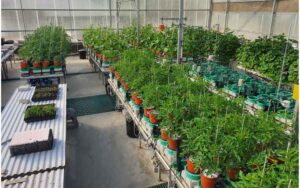
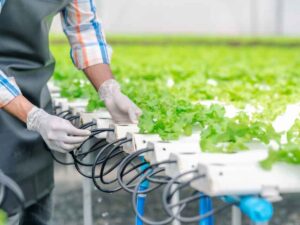
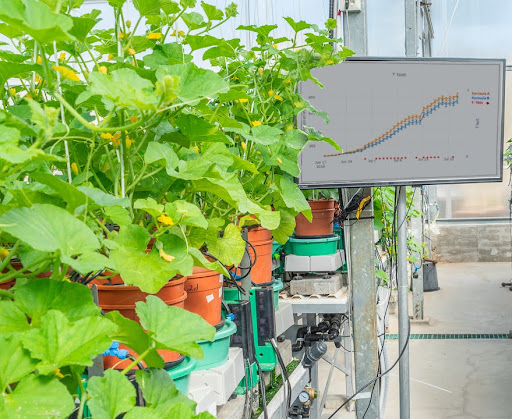
Plant breeding for stress environments requires identifying genetic traits that enable crops to maintain productivity. Traditional phenotyping methods struggle to capture dynamic physiological responses. This creates bottlenecks in breeding programs. Plant-ditech’s high-throughput platform, the PlantArray system, solves this issue. It enables continuous, precise measurements of water use efficiency, transpiration dynamics, and stomatal behavior across hundreds of genotypes simultaneously.
Genetic Discoveries from Cowpea and Chickpea Research
Research published in Frontiers in Genetics demonstrated the power of PlantArray systems. They distinguished drought response patterns in cowpea germplasm. This revealed genetic variation in transpiration rates impossible to detect through conventional methods. A complementary chickpea study identified key physiological markers. These included transpiration response curves and nocturnal water loss patterns associated with drought tolerance. Genome-wide association studies (GWAS) integrated PlantArray data to uncover the genetic architecture of drought responses. This identified quantitative trait loci (QTL) for dynamic transpiration patterns and water conservation strategies.
From Physiological Data to Molecular Breeding Tools
This integration of high-resolution phenotyping with genomic tools transforms breeding efficiency, enabling selection based on physiological performance under actual stress conditions rather than indirect morphological proxies. The molecular markers identified through these studies provide breeders with tools to select superior genotypes efficiently. Plant-ditech platforms make this precision breeding approach accessible to research programs worldwide.
How Does Genomic Selection Accelerate Stress-Resilient Crops?
Genomic selection employs genome-wide marker data to predict breeding values of individuals before phenotypic evaluation, enabling selection decisions at earlier growth stages and dramatically reducing breeding cycle duration compared to conventional approaches. By enabling selection among seedlings or even embryos, breeders can complete multiple selection cycles per year rather than waiting for full crop maturity and field evaluation, which traditionally requires entire growing seasons and extensive resource commitments for each selection cycle.
This Modern breeding programs increasingly combine genomic selection for early-stage screening with phenotypic validation at later stages, optimizing both speed and accuracy in identifying superior genotypes for plant breeding for stress environments.
Breeding Method | Cycle Duration | Best Application | Key Advantage |
Conventional Selection | 6-10 years | Polygenic traits | No specialized equipment |
Marker-Assisted Selection | 4-6 years | Major QTL introgression | Precise gene tracking |
Genomic Selection | 2-4 years | Complex quantitative traits | Early-stage prediction |
CRISPR-Based Editing | 2-3 years | Known target genes | Precise modification |
This table highlights the differences between major plant breeding methods and shows how each approach fits specific research goals.
The progression from traditional selection to advanced tools like genomics and CRISPR demonstrates significant reductions in development time and improvements in genetic precision. Choosing the right method depends on trait complexity, research objectives, and required accuracy, with modern technologies offering faster and more reliable results.
Which Key Traits Help Plants Tolerate Heat Stress?
Heat tolerance in plants depends on multiple properties connected to each other, including heat shock protein production, membrane thermostability, ability to stay green, and a different root architecture that works synergistically to maintain function at high temperatures. These properties protect cellular machinery, maintain photosynthetic capacity and ensure adequate water and nutrients uptake during high-temperature episodes when normal physiological processes face disruption. The green staying feature inhibits leaf aging under stress, allowing plants to maintain photosynthetic capacity and continue to harvest during critical grain-filling periods when many varieties show premature aging. Modern phenotype platforms can now assess root properties in a non-destructive way using various imaging technologies, speeding up the selection of properties underground.
Trait Category | Specific Traits | Stress Type | Selection Method |
Molecular Protection | Heat shock proteins, LEA proteins | Heat, drought | Molecular markers, expression analysis |
Osmotic Adjustment | Proline accumulation, soluble sugars | Drought, salinity | Biochemical assays, phenotyping |
Water Relations | Stomatal conductance, WUE | Drought, heat | Gas exchange, gravimetric systems |
Root Architecture | Root depth, density, angle | Drought, nutrient stress | Imaging, phenotyping platforms |
Canopy Characteristics | Stay-green, leaf rolling | Heat, drought | Visual scoring, spectral indices |
The table summarizes major plant traits that contribute to stress tolerance, the types of stress they address, and how they are selected. Molecular and osmotic traits help plants cope with heat, drought, and salinity through protective proteins and osmolytes. Water-relation traits improve efficiency under drought and heat, while root architecture traits enhance access to water and nutrients. Canopy traits support heat and drought resilience at the whole-plant level. Each trait category is evaluated using appropriate molecular, biochemical, physiological, or imaging-based methods.
What Role Does CRISPR Play in Building Climate-Resilient Varieties?
Crispr-X9 genome editing enables precise modification of specific genes that control stress responses, offering unprecedented precision in crop improvement without introducing foreign DNA from other species or creating unwanted genetic changes. This technology has revolutionized plant growth by allowing researchers to create targeted mutations, activate or suppress specific genes and present beneficial allele variants with minimal off-target effects that may impair other desirable traits. Tomato edited by קריספר proven fertility is maintained at temperatures exceeding 35 degrees Celsius, a threshold critical factor usually fail breeding a loss of crop complete. This breakthrough relates to one of the most temperature-sensitive stages in crop production, since heat stress during flowering can eliminate crop potential even in otherwise healthy plants.