
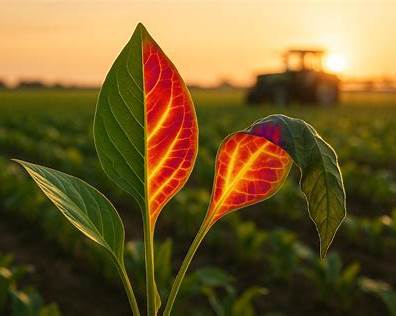



Agricultural productivity faces a critical challenge from plant stress. Biotic stresses, including pests and diseases, along with abiotic factors like drought and salinity, can reduce crop yields by 25-70% depending on conditions. The solution lies not in waiting for visible symptoms but in detecting these stresses at their earliest stages, when intervention can still prevent irreversible damage.
When plants experience stress, they undergo physiological changes long before any visual symptoms emerge. Research from NASA and leading agricultural institutions demonstrates that these presymptomatic changes can be detected up to 16 days before damage becomes visible to the human eye. This window of opportunity transforms agricultural management from reactive to proactive.
What Is Early Detection Of Plant Stress?
Early detection of plant stress refers to the identification of physiological changes in plants before visible symptoms appear. This approach monitors specific indicators such as chlorophyll fluorescence, stomatal conductance, leaf temperature, and spectral reflectance patterns. Unlike traditional methods that rely on observing yellowing leaves or wilting, early detection technologies measure biochemical and biophysical changes at the cellular level.
Plants respond to stress through a cascade of mechanisms. Stomatal conductance decreases within hours of drought exposure. Chlorophyll content begins shifting in response to nutrient deficiencies days before color changes become apparent. Thermal signatures alter as transpiration patterns shift under water stress. These changes create detectable signals that modern sensors can capture and analyze.
How Does Early Plant Stress Detection Work?
The process combines optical sensing technologies with data analysis. Sensors capture information across multiple wavelengths of the electromagnetic spectrum, from ultraviolet through near-infrared. Each stress type creates unique patterns in how plants absorb, reflect, and emit light at different wavelengths.
Thermal imaging detects temperature variations caused by stomatal closure. When plants close their stomata in response to stress, transpiration decreases and leaf temperature rises. Infrared cameras can detect temperature differences as small as 0.5°C, revealing stress responses invisible to standard observation.
Spectral Analysis and Reflectance Patterns
Hyperspectral imaging captures data across hundreds of narrow wavebands. The red edge region, particularly wavelengths between 690-730 nm, proves especially sensitive to chlorophyll changes. Studies show that reflectance at 694 nm divided by reflectance at 760 nm can detect stress simultaneously with physiological measurements, days before visual symptoms emerge.
Chlorophyll fluorescence imaging measures the efficiency of photosystem II. When plants experience stress, the fraction of open PSII reaction centers decreases, a change detectable within 15 minutes of pest feeding or 30 minutes after pathogen application according to research on tomato plants.
Which Technologies Enable Early Detection Of Plant Stress?
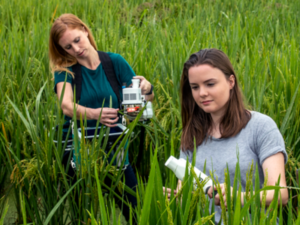
Multiple technologies have emerged for stress detection, each with distinct advantages. Remote sensing platforms including satellites and UAVs provide field-scale coverage. These systems detect chemical and physical properties of crops from varying distances, allowing investigation of entire fields throughout growing seasons.
|
Technology |
Detection Time |
Application Scale |
Key Advantage |
|
Chlorophyll Fluorescence |
15-30 minutes |
Individual plants to canopy |
Non-destructive, real-time |
|
Thermal Imaging |
Hours to days |
Plant to field level |
Detects water stress early |
|
Hyperspectral Imaging |
1-5 days |
Leaf to field level |
Multiple stress types |
|
Multispectral Sensors |
2-7 days |
Field to landscape |
Cost-effective coverage |
This table compares four technologies for detecting plant diseases before visible symptoms appear. Chlorophyll radiation offers the fastest detection (15-30 minutes) for individual plants using non-destructive, real-time monitoring. Thermal imaging detects water pressure within hours to days at the field level. Hyperspectral imaging (15 days) detects many types of pressure from the ascent to the field scale. Multi-spectral sensors (2-7 days) provide cost-effective monitoring for large agricultural areas. The speed of detection usually decreases as the coverage area increases.
Why Is Timing Critical in Plant Stress Detection?
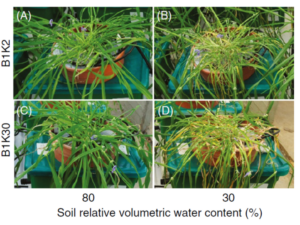
Visible symptoms appear only after plants have already suffered metabolic damage. Chlorosis and necrosis, the typical visual indicators used for diagnosis, are associated with high metabolic costs and reduced assimilates. Research on wheat demonstrates that drought stress at critical growth stages can cause yield losses up to 69%.
Grain filling in cereals depends on four major enzymes, Sucrose Synthase, Starch Synthase, Starch Branching Enzyme, and Adenosine Diphosphate Glucose Pyrophosphorylase. Stress decreases the activity of these enzymes long before visible symptoms appear, directly impacting final yield. Early intervention can maintain enzyme activity and protect yield potential.
How Do Plants Signal Stress at the Molecular Level?
Plant biomarkers serve as measurable indicators of cellular responses to external stimuli. These molecular signals appear before macroscopic symptoms, providing early warning of stress conditions. Heat shock proteins accumulate within hours of temperature stress. Abscisic acid levels rise during drought, triggering stomatal closure and stress response genes.
Reactive oxygen species increase under various stress conditions, causing oxidative damage detectable through histochemical staining. Antioxidant enzymes including superoxide dismutase, catalase, and peroxidase show altered activity patterns. These changes correlate with stress severity and can guide intervention timing.
Electrical Conductivity as an Early Indicator
The internal electrical conductivity in plant stems reflects physiological activity including ion and water transport. Studies on pepper plants show that monitoring stem conductivity can indicate environmental stress induced by low temperature and salt before visible changes appear. This non-invasive approach provides continuous monitoring without damaging the plant.
Can Early Detection Systems Prevent Yield Loss?
Prevention depends on intervention timing and stress reversibility. Some stress effects become irreversible after critical thresholds. Drought stress at the tasseling stage in maize results in significant yield loss even with subsequent irrigation. Cotton exposed to water deficit during boll formation shows reduced lint yield regardless of later water availability.
However, many stresses remain reversible when caught early. Nutrient deficiencies corrected before severe chlorosis develops allow plants to resume normal growth. Disease management initiated at the presymptomatic stage prevents pathogen establishment and reduces treatment costs.
|
Crop |
Stress Type |
Critical Stage |
Potential Yield Loss |
|
Wheat |
Drought |
Tillering to grain filling |
Up to 69% |
|
Maize |
Drought |
Tasseling |
30-50% |
|
Cotton |
Drought |
Boll formation |
40-60% |
|
Pearl Millet |
Drought |
Flowering |
Complete sterility |
This table shows how drought affects major crops during critical growth stages. Wheat loses up to 69% yield when drought occurs during tillering to grain filling. Maize suffers 30-50% losses during tasseling. Cotton experiences 40-60% reduction during boll formation. Pearl Millet faces complete sterility if drought strikes during flowering. The data highlights that drought during reproductive stages causes catastrophic yield losses, emphasizing the need for water management during these vulnerable periods.
How Does Automated Phenotyping Advance Stress Detection?
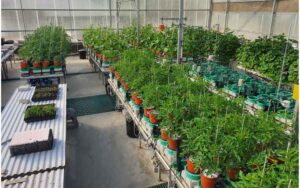
Modern phenotyping platforms measure 500 dynamic physiological and environmental data points daily. These systems control soil moisture, temperature, humidity, and light conditions while continuously monitoring plant responses. This level of data density reveals stress responses that would be impossible to detect through manual observation.
Automated systems enable comparative studies under reproducible conditions. Multiple genotypes can be screened simultaneously under identical stress protocols. The resulting data quantifies not just stress detection but also stress tolerance mechanisms, informing breeding strategies.
Real-Time Monitoring Capabilities
Continuous measurement reveals the temporal dynamics of stress responses. Some stresses manifest within hours, others develop over days. Real-time monitoring captures these different time scales, providing insights into both immediate responses and longer-term adaptation mechanisms.
Plant-DiTech’s automated phenotyping platform exemplifies this approach. The system measures water use, stomatal activity, root function, and plant growth simultaneously while simulating diverse environmental conditions. Researchers can detect yield potential and stress responses weeks before visual signs appear, compressing research timelines from seasons to weeks.
Transforming Agricultural Management Through Early Detection
The shift from reactive to proactive crop management represents a fundamental change in agricultural practice. Traditional approaches wait for problems to become visible before responding. Early detection inverts this paradigm, enabling intervention while plants remain healthy and resilient.
Economic benefits extend beyond yield protection. Reduced pesticide use through targeted application. Water conservation through precision irrigation. Faster breeding cycles through automated phenotyping. These advantages compound across the agricultural value chain.
Frequently Asked Questions:
How early can plant stress be detected before visible symptoms?
Plant stress can be detected 1-16 days before visible symptoms appear, depending on the stress type and detection method. Chlorophyll fluorescence can identify stress within 15-30 minutes of exposure, while thermal and spectral methods typically detect changes 2-7 days before visual symptoms emerge.
What is the most cost-effective method for early stress detection?
Thermal imaging provides an excellent balance of cost and effectiveness for many applications. Modern thermal cameras detect temperature variations caused by stomatal closure, revealing water stress before wilting appears. RGB imaging combined with machine learning also offers accessible early detection at lower equipment costs.
Can early detection systems differentiate between stress types?
Yes, different stresses create distinct physiological signatures. Machine learning models trained on multi-spectral or hyperspectral data can classify stress types with 94-100% accuracy in research settings. However, accuracy depends on sensor quality, environmental conditions, and the specific stress-crop combination.
How accurate are automated phenotyping systems for stress detection?
Automated phenotyping platforms achieve high precision through continuous monitoring of multiple parameters. Systems measuring 500+ data points daily can detect stress responses that manual observation would miss entirely. These platforms provide quantitative measurements suitable for research and breeding applications where accuracy is critical.
What role does artificial intelligence play in plant stress detection?
Artificial intelligence analyzes complex patterns in sensor data that human observers cannot process. Deep learning models identify subtle combinations of spectral signatures, thermal patterns, and physiological parameters that indicate specific stress conditions. AI enables real-time classification and can learn to recognize new stress patterns as.
Take Your Research to the Next Level with Plant-DiTech
Ready to revolutionize your plant stress research? Plant-DiTech’s cutting-edge automated phenotyping platform sets the industry standard for early detection of plant stress. Our PlantArray system measures 500 dynamic physiological and environmental data points daily, capturing water use, stomatal activity, root function, and plant growth with unprecedented precision.
Whether you’re a researcher developing stress-tolerant cultivars, an agronomist optimizing crop management strategies, or a breeder accelerating selection programs, Plant-DiTech provides the tools to detect stress responses weeks before visual symptoms appear.
Join leading research institutions worldwide who trust Plant-DiTech for their plant phenotyping needs. Contact us today to discover how our advanced early detection of plant stress solutions can accelerate your research, improve yields, and enhance resource efficiency in your agricultural programs.