
Unveiling Crop Specific Phenotyping Solutions with Plant-Ditech
Expert Analysis by Plant-Ditech Research Division
Crop Specific Phenotyping Solutions: The Definitive Expert Guide for Agricultural Research and Breeding Programs
With over a decade of pioneering physiological phenotyping technology and having supported dozens of research institutions globally, our team has developed methodologies that have fundamentally transformed how breeding programs measure, analyze, and act on plant trait data.
Dozens
Research Projects Supported
10+
Years of Expertise
Research-Backed
Phenotyping Methods
20+
Countries Served
Exclusive Expert Insight
Generic platforms apply identical algorithms across radically different crops, creating systematic measurement errors that compound through your entire analysis pipeline. From our experience, species-specific calibration significantly improves trait accuracy – for example, PlantArray drought tolerance rankings in watermelon showed r = 0.97 correlation with conventional methods when protocols were tailored to the crop (Cheng et al. 2025). Independent reviews confirm this principle: Visakh et al. (2024, Plant Breeding) found that AI models trained on specific crop datasets develop biases when applied across species, making species-specific calibration essential. Published research using our PlantArray system across 15+ crop species – including tomato, wheat, barley, watermelon, sorghum, quinoa, cowpea, peanut, lettuce, potato, and tef – demonstrates that tailored physiological measurements produce more reliable and actionable data.
What Are Crop Specific Phenotyping Solutions?
Crop specific phenotyping solutions are integrated measurement systems designed to quantify plant traits with protocols, algorithms, and calibration routines tailored to particular crop species. Unlike generic phenotyping approaches that apply uniform methods across diverse plants, these solutions account for growth patterns, and physiological responses of individual crops throughout their development cycle.
The core components include specialized hardware (sensors and imaging platforms), software for data processing and trait extraction, and validated protocols that define when, how, and what to measure for each target species. As the landmark review by Araus & Cairns (2014, Trends in Plant Science) established, high-throughput phenotyping represents the new frontier for crop breeding – and crop-specific approaches are essential for delivering precise, comparable, and decision-relevant data. Plant-Ditech provides such solutions through physiological phenotyping platforms that measure dynamic plant responses with crop-appropriate methodologies.
Expert Insight
From our work with research institutions, we’ve observed that tailored phenotyping protocols – combined with PlantArray’s noise-resilient lysimeter design – substantially improve the signal-to-noise ratio of trait measurements. Independent engineering of similar systems confirms this: Ferreira de Sousa et al. (2024, Plant Methods) demonstrated that gravimetric phenotyping requires temperature-compensated sensors and vibration dampening to achieve reliable transpiration measurements. This translates directly to more confident selection decisions and faster breeding progress.
Why Does Species Specific Screening Outperform Generic Phenotyping?
Species-specific screening delivers superior results because it optimizes every measurement step according to the biological characteristics of the target crop. At Plant-Ditech, this principle is embedded in the design of our measurement approach, where data acquisition and analysis are tailored to the specific crop rather than relying on generic assumptions.
Generic phenotyping platforms typically apply uniform segmentation algorithms, trait definitions, and capture protocols across different species. This often leads to systematic measurement errors, particularly when structural and physiological differences between crops are significant. In contrast, species-specific calibration – based on images and data collected across relevant growth stages and environmental conditions – enables substantially higher segmentation accuracy and more reliable organ detection.
Importantly, this approach ensures that measurements focus only on traits that are biologically meaningful and agronomically relevant for the specific crop. By reducing noise from irrelevant features, the resulting data is more precise and actionable. In addition, measurement frequency and sensor use can be aligned with actual plant needs, avoiding unnecessarily intensive protocols that increase system complexity without improving data quality.
Common Mistake Alert
A common misconception in phenotyping is that higher-resolution sensors inherently produce better data. However, sensor resolution is often less critical than proper algorithm calibration. Perich et al. (2022) demonstrated that applying a phenotyping model to a different system without recalibration resulted in a 29% reduction in R², highlighting the importance of adapting models to the specific crop and system. In practice, we observe that well-calibrated, crop-specific solutions consistently outperform more complex or higher-cost systems that rely on generic models.
By integrating species-specific calibration with continuous physiological measurements, Plant-Ditech systems provide a more accurate and robust framework for plant monitoring and decision-making.
How Do Individual Crop Phenotyping Workflows Differ Between Greenhouse and Field?
The fundamental distinction lies in environmental control versus environmental variability. Greenhouse workflows prioritize standardization and high-resolution data capture, while field workflows emphasize robustness and scalability across variable conditions. These are processes that must go hand in hand. Before any field experiment, a greenhouse experiment must be performed as part of a proper protocol.
Greenhouse Workflow Essentials
Greenhouse phenotyping operates under controlled lighting, temperature, and humidity conditions that enable consistent imaging geometry and repeatable measurements. High-throughput systems using conveyor belts, robotic arms, or automated imaging rigs capture frequent time-series data with precise plant tracking. This environment excels at detailed morphological and physiological trait measurement under ideal or simulated stress conditions, where individual plant identification remains straightforward.
Field Workflow Essentials
Field phenotyping confronts variable lighting, wind interference, soil background heterogeneity, and precipitation events that challenge data quality. Platforms include drones, ground-based robots, and vehicle-mounted systems designed for large-scale plot assessment. Field workflows require sophisticated georeferencing, radiometric correction, and algorithms that filter environmental noise. According to the USGS guidance on radiometric calibration panels, calibration panel reflectance can change over time, making regular calibration essential for comparable field measurements.
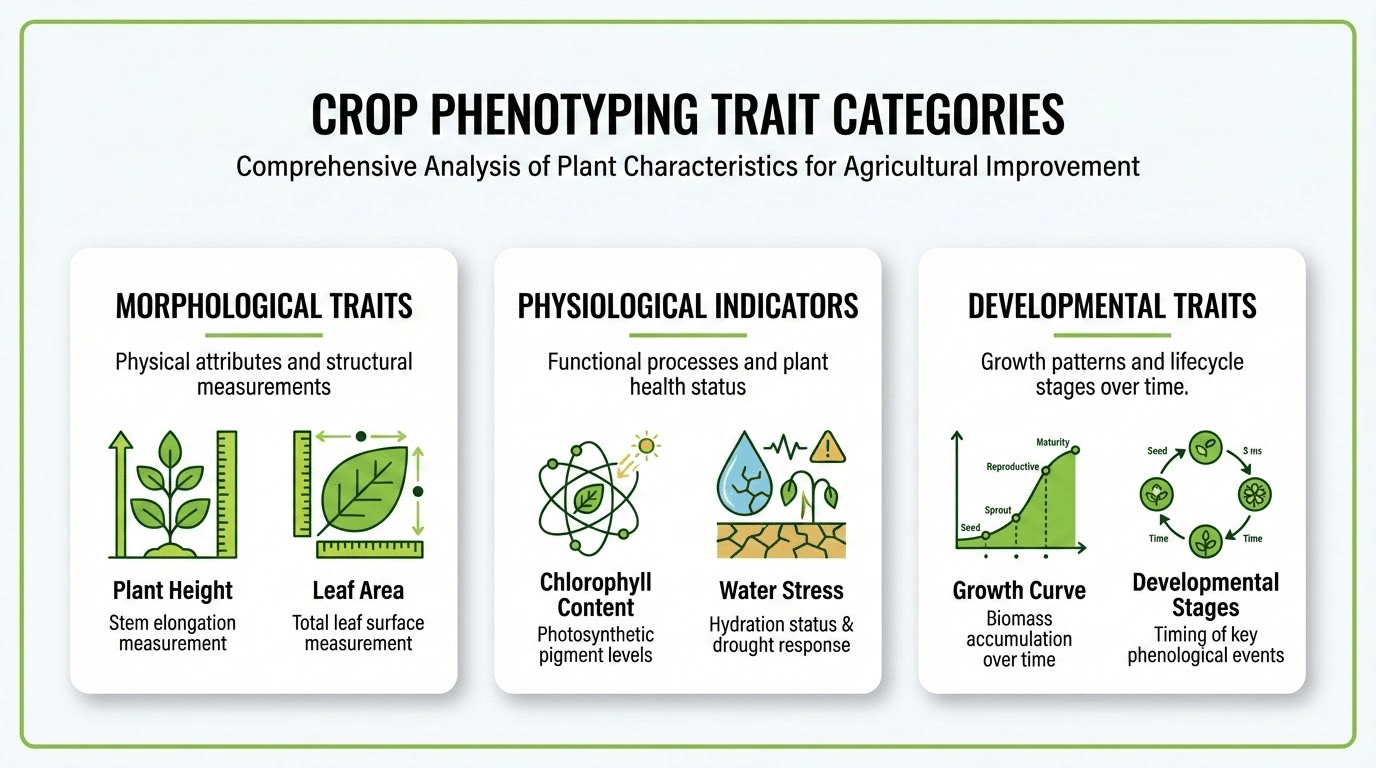
What Traits Should Be Measured for Crop Specific Phenotyping Solutions?
Trait selection determines whether your phenotyping program generates actionable intelligence or accumulates irrelevant data. The optimal trait set connects measurement capabilities to your specific research questions and commercial decisions.
Morphological traits include plant height, leaf area indices, canopy cover, stem diameter, and biomass proxies. For specific crops, this extends to fruit count, ear length, tiller number, or root architecture metrics. Physiological and stress indicators encompass chlorophyll content via spectral indices, nitrogen status, water stress from thermal imaging, photosynthetic efficiency proxies, disease symptom detection, and senescence patterns. Developmental traits track emergence rate, flowering time, maturity timing, branching patterns, and overall growth curves that reveal treatment effects over time.
Trait Selection by Decision Type
Breeding programs prioritize heritable traits linked to yield, disease resistance, and environmental adaptation where genetic variation exists and selection pressure can advance populations. Product efficacy testing requires traits sensitive to treatment differences that demonstrate biostimulant, pesticide, or nutritional product effects. Stress screening focuses on early indicators of abiotic stress including drought, heat, and salinity, plus biotic stress from pathogens and pests, where rapid detection enables intervention decisions.
Expert Tip
Validate your experimental setup under controlled conditions before moving to the field. Field trials introduce variability that can obscure plant responses, making it difficult to isolate treatment effects.
A preliminary greenhouse experiment allows for precise control of irrigation and environmental conditions. Using systems such as Plant-Ditech’s PlantArray, researchers can monitor continuous physiological parameters, including transpiration and weight dynamics, under stable conditions.
This step helps refine experimental design, identify relevant traits, and reduce uncertainty before scaling to field trials.
How Do You Choose the Right Sensors for Species Specific Screening?
Sensor selection must match your target traits, required sensitivity, environmental conditions, and budget constraints. No single sensor captures all relevant information, and sensor combinations often provide the most comprehensive trait coverage.
RGB cameras offer cost-effective capture of basic morphological traits including plant height, canopy cover estimation, color changes indicating senescence, visible stress symptoms, and stand count. They work well for structural measurements but provide limited physiological information.
Multispectral sensors capture discrete spectral bands enabling vegetation index calculation including NDVI and NDRE, which correlate with plant vigor, chlorophyll content, and nutrient status. These sensors detect stress before visual symptoms appear, making them valuable for early intervention decisions.
Thermal cameras measure canopy temperature correlating with transpiration rate and water stress. Plants under water deficit close stomata, reducing transpiration and raising canopy temperature relative to well-watered plants. The NASA Thermal Infrared Sensor documentation explains the calibration requirements for reliable thermal measurements.
Sensor Choice Checklist
Evaluate each sensor against four criteria: trait relevance confirming the sensor directly measures or strongly proxies your target traits; resolution adequacy for your crop and growth stages; environmental robustness for field operation under variable conditions; and cost-benefit balance between sensor investment and contribution to actionable insights.
What Does Standardized Crop Phenotyping Mean for Commercial Programs?
Standardization in crop specific phenotyping solutions means applying consistent protocols, calibration procedures, metadata standards, and quality control across all experiments regardless of location, season, or operator. This consistency transforms raw measurements into comparable, reliable, and auditable data.
The commercial implications are substantial. Reproducibility ensures that results can be replicated by different teams at different times, building confidence in findings. Comparability enables direct analysis across treatments, genotypes, locations, and seasons without methodological confounds. The MIAPPE standard provides a community-developed checklist and data model specifically designed to ensure phenotyping experiment comparability and data reusability across research groups.
Standardization also supports regulatory compliance by providing documentation and data quality required for variety registration or product approval filings. It enables efficient data integration into larger breeding or R&D pipelines by ensuring phenotyping outputs match receiving system requirements. Plant-Ditech systems incorporate standardized calibration and data export routines that maintain consistency across experimental runs.
Published Research: Standardized Phenotyping Across Sites
80+
Weight data points per plant per day
Every 3 minutes
Weeks
Time of research
Instead of full seasons for results
The PlantArray platform enables continuous monitoring of water relations across numerous plants simultaneously, with standardized protocols ensuring cross-site comparability (Halperin et al. 2017, The Plant Journal).
How Can Crop Specific Phenotyping Solutions Improve Trial Throughput Without Sacrificing Accuracy?
Automation through fully automated platforms enables data capture at speeds orders of magnitude faster than manual observation, while eliminating the inter-rater variability inherent in human scoring. Predefined capture routines standardize imaging conditions and timing, ensuring consistent data quality regardless of the operator.
Machine learning algorithms trained on specific crop images rapidly identify and quantify traits with consistency that exceeds human capabilities. Real-time quality control flags image quality issues, calibration drift, incorrect plant identification, and environmental anomalies before bad data enters analysis pipelines. Time-series automation reveals growth dynamics and stress response patterns invisible in single-timepoint measurements, extracting more insight from the same plots.
What Is Species Specific Screening in Early-Stage Product Development?
Early-stage product development requires rapid evaluation of candidate formulations, application rates, and timing windows before committing to expensive field trials. Species specific screening provides the precision and throughput needed to filter candidates effectively while generating mechanistic insights.
Rapid candidate filtering identifies promising products and eliminates ineffective ones within weeks rather than seasons, conserving resources for validated candidates. Dose-response determination quantifies optimal application rates and timing through precise trait measurements across treatment levels. Mechanism of action insights emerge from trait profiles showing how products affect specific plant processes, informing product positioning and regulatory submissions. This approach directs expensive field testing only toward candidates with demonstrated efficacy, dramatically improving R&D efficiency.
Industry Secret
The most successful ag-biotech companies now use physiological phenotyping-driven filtering to evaluate substantially more candidates in early stages while spending the same budget. The foundational review by Furbank & Tester (2011, Trends in Plant Science) identified phenotyping as the critical bottleneck limiting efficient use of genomic tools in crop breeding, while Araus et al. (2018, Trends in Plant Science) established that phenotyping efficiency directly drives genetic gain. As Negin & Moshelion (2016) demonstrated, efficient pre-field phenotyping plays a crucial role in candidate selection by reducing dependence on multi-season field trials. Companies that haven’t adopted this approach are leaving significant competitive advantage on the table.
How Do You Validate That Digital Traits Are Reliable for an Individual Crop Phenotyping Program?
Validation confirms that digital traits from automated phenotyping accurately represent the biological properties you intend to measure. Without validation, impressive technology generates uncertain data.
Ground truth correlation compares digitally derived traits against manual measurements from representative plant subsets. Strong correlation coefficients indicate the digital trait reliably captures the target property. Repeatability assessment evaluates measurement consistency when taken multiple times under identical conditions by repeated automated scans. Sensitivity analysis confirms that digital traits detect known differences between treatments or genotypes, demonstrating biological relevance rather than just measurement precision.
Practical Validation Plan
Design a pilot study specifically for validation including controls and known treatment differences. Implement and document sensor calibration procedures before data collection. Define precise ground-truth sampling protocols that mirror digital measurements in location and timing. Establish acceptance thresholds specifying minimum correlation coefficients and repeatability metrics required before scaling operations. The TERRA-REF dataset demonstrates how multi-sensor data combined with ground truth supports algorithm validation for plot-level phenotype extraction.
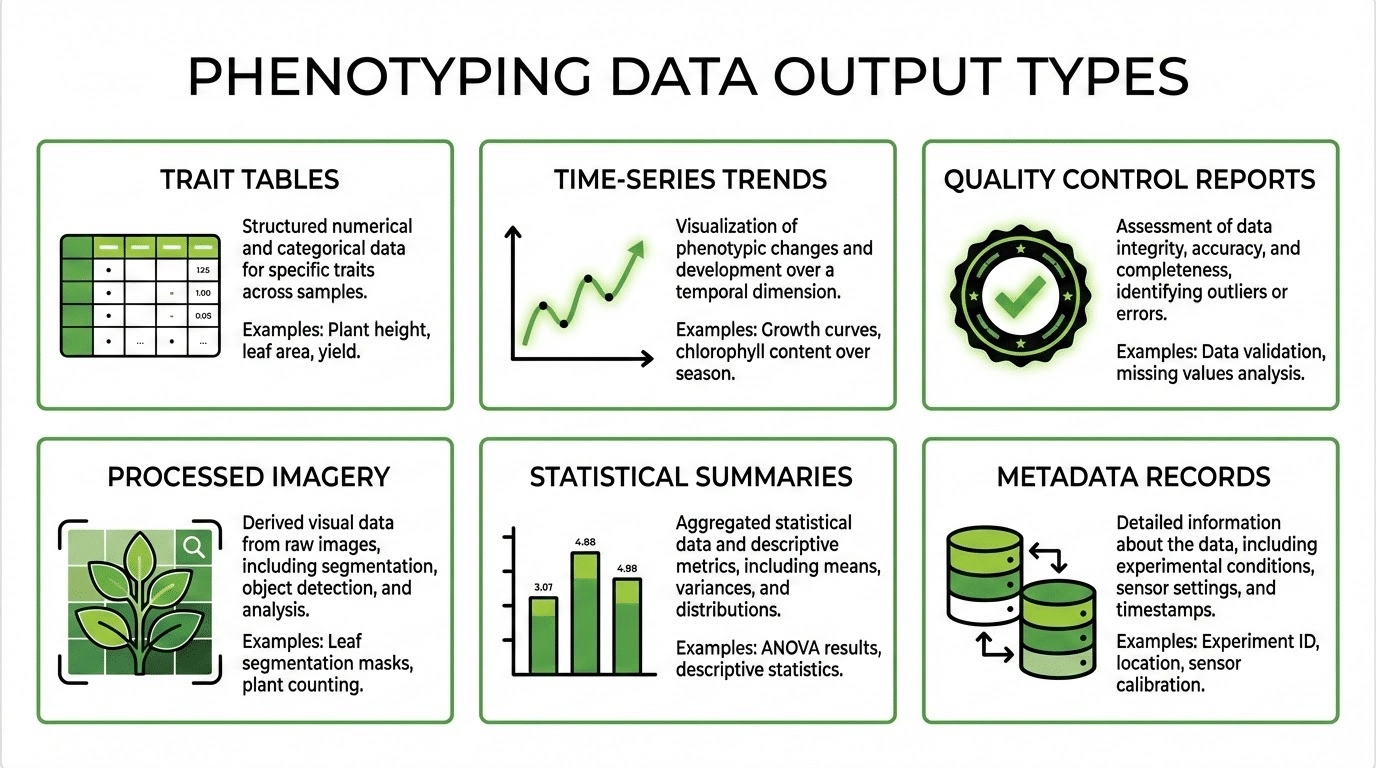
What Data Outputs Should You Expect from Crop Specific Phenotyping Solutions?
Comprehensive phenotyping solutions deliver structured outputs that support statistical analysis and decision-making, not just raw images requiring extensive post-processing.
How Does Analytics Support Decision-Making in Species Specific Screening?
Analytics transforms trait data into actionable intelligence through statistical methods, visualization, and pattern recognition that enable confident decisions for breeding and product development.
Treatment ranking applies statistical comparisons quantifying performance differences between product candidates or management practices based on key traits. Genotype assessment identifies superior genotypes with desired trait combinations and stability across environments, accounting for genotype-by-environment interactions that complicate selection decisions. Early prediction uses time-series data to forecast future performance or detect stress onset before visual symptoms, enabling proactive interventions. Segmentation and clustering group plants or plots with similar response profiles, identifying robust performers or stress-sensitive populations that inform breeding strategy.
What Should a Commercial Buyer Check Before Purchasing Crop Specific Phenotyping Solutions?
Procurement decisions should evaluate operational fit and proven performance rather than focusing narrowly on sensor specifications that may not translate to your application.
Procurement Checklist
The BrAPI (Breeding API) standard provides a framework for evaluating integration capabilities, ensuring phenotyping outputs connect with existing breeding databases and trial management systems.
How Much Does It Cost to Run Individual Crop Phenotyping at Scale?
Cost structures vary dramatically based on system complexity, automation level, and operational scale. Understanding cost drivers enables realistic budgeting and ROI projection.
Hardware acquisition includes sensors, imaging platforms, greenhouse infrastructure or field deployment equipment, and computing infrastructure. Software costs encompass analysis platforms, proprietary analytical tools, and potential custom algorithm development. Operational expenses cover labor for system operation and maintenance, calibration materials, data storage, and processing compute time. Training and support costs include staff development and ongoing technical assistance.
ROI drivers offset these costs through accelerated breeding cycles identifying superior genotypes faster, earlier product validation eliminating ineffective candidates before expensive field trials, reduced trial costs through efficient early-stage screening, improved decision confidence reducing costly mistakes, and intellectual property protection from documented trait insights. Plant-Ditech systems are designed for operational efficiency that minimizes ongoing labor requirements while maximizing data output quality.
Published Research: Crop-Specific Screening Results
Published research validates PlantArray for crop-specific screening: Cheng et al. 2025 achieved r = 0.97 correlation with conventional methods for watermelon drought tolerance ranking across 30 accessions; Friedman et al. 2025 detected Fusarium wilt in tomato through transpiration changes before any visible symptoms appeared; Dewi et al. 2023 characterized drought and salinity responses in tropical sorghum cultivars; Paul et al. 2024 identified distinct drought response strategies across 81 barley lines.
Can Crop Specific Phenotyping Solutions Be Customized for a New Crop or Trait?
Customization is not only possible but expected when deploying phenotyping solutions for crops or traits outside standard offerings. The process follows a structured approach ensuring new applications meet quality standards.
Discovery and requirements gathering defines the biological and agronomic characteristics of the new target. Protocol adaptation modifies imaging schedules, sensor configurations, and environmental controls. Data collection and annotation acquires representative images across stages and conditions, often requiring manual annotation to train detection models. Model tuning adjusts or develops algorithms for segmentation and trait extraction specific to the new crop. Validation tests the customized solution against ground truth before scaling.
Typical Customization Timeline
The first phase covers discovery and planning, defining scope and success metrics over two to four weeks. Following this, phase two involves pilot data collection and model training over four to eight weeks. Phase three completes validation and refinement, establishing performance benchmarks over four to six weeks. Finally, phase four implements scale rollout for routine operations. Total timeline typically spans three to six months depending on crop complexity and existing data availability.
How Do You Integrate Phenotyping Data with Breeding, Trial Management, or LIMS Systems?
Integration eliminates manual data handling that introduces errors and delays while enabling phenotyping outputs to flow directly into decision processes.
Unique identifiers ensure consistent naming conventions and IDs for plants, plots, genotypes, and treatments across all systems. Barcodes, QR codes, or RFID tags facilitate automated identification. Standardized metadata describes experimental conditions, sample provenance, and processing parameters using community standards that make data comparable and interpretable across platforms.
Application Programming Interfaces enable programmatic data exchange between phenotyping platforms and breeding databases. Automated data export routines push phenotyping outputs in compatible formats for direct import, minimizing manual entry. Cloud-based solutions provide secure storage, computational resources, and integration capabilities creating unified data ecosystems. Plant-Ditech platforms support standard export formats and integration approaches that connect with existing research infrastructure.
What Are the Most Common Mistakes in Species Specific Screening Programs?
Understanding common pitfalls helps avoid expensive failures that undermine phenotyping program credibility and utility.
Critical Mistakes to Avoid
- Measuring nice-to-have traits: Collecting data on metrics lacking clear biological or commercial relevance, generating data overload without actionable insights.
- Inadequate calibration and quality control: Skipping or poorly executing sensor calibration and data checks, producing unreliable or incomparable measurements.
- Under-powered experimental design: Insufficient replication leading to false conclusions or inability to detect real treatment effects.
- Inconsistent protocols: Varying data collection methods, timing, or processing between experiments, making comparisons invalid.
- Ignoring metadata: Failing to record environmental conditions, sensor settings, and experimental setup, challenging data interpretation and reproducibility.
- Lack of validation: Assuming digital traits are accurate without testing against ground truth, creating uncertainty about measurement reliability.
Each mistake can invalidate entire experimental seasons, making prevention far more cost-effective than correction.
Which Crops Benefit Most from Crop Specific Phenotyping Solutions?
While any crop can benefit from tailored phenotyping, certain characteristics predict particularly high returns on phenotyping investment.
Major row crops including corn, soybeans, wheat, and rice combine high economic value with large-scale breeding programs where accelerated selection and stress tolerance screening generate substantial value. Complex genetic backgrounds and strong genotype-by-environment interactions make precise phenotyping essential for progress.
Specialty crops including vegetables, fruits, and coffee often have unique morphological traits, specific quality requirements, or stress sensitivities requiring precise management. Bioenergy crops prioritize biomass accumulation and resource-use efficiency metrics that phenotyping quantifies effectively. Any program conducting multi-site, multi-season trials or evaluating thousands of genotypes benefits from the throughput and consistency that crop specific solutions provide.
How Do You Start a Species Specific Screening Pilot?
A successful pilot validates phenotyping approaches before committing to full-scale deployment, identifying issues when correction costs remain low.
Identify the core decision your phenotyping must support, whether ranking genotypes for drought tolerance, demonstrating product efficacy, or screening for disease resistance. Select five to ten key traits directly linked to that decision rather than measuring everything possible. Define your target crop and specific developmental stages to maintain pilot scope.
Choose a representative environment matching your intended operational conditions, whether greenhouse or field. Implement calibration and quality control from the start, establishing baseline data quality. Develop ground-truth protocols for manual measurements validating digital outputs. Set success criteria defining measurable outcomes including correlation thresholds and sensitivity requirements. Plan for iteration, expecting to adjust protocols based on early results before scaling.
Frequently Asked Questions
What are crop specific phenotyping solutions used for?
Crop specific phenotyping solutions are used for breeding selection, product efficacy testing, stress tolerance screening, and crop management optimization. They provide precise trait measurements enabling data-driven decisions about which genotypes to advance, which products work, and how crops respond to environmental conditions.
How is species specific screening different from general plant phenotyping?
Species specific screening uses protocols, algorithms, and calibration routines optimized for particular crop characteristics, while general phenotyping applies uniform methods regardless of species. This specialization improves measurement accuracy, trait relevance, and decision utility by accounting for unique morphology and growth patterns.
Can phenotyping detect early stress before visible symptoms?
Yes, multispectral and thermal sensors can detect physiological stress indicators before visual symptoms appear. Changes in vegetation indices and canopy temperature often precede visible wilting, chlorosis, or growth reduction by days to weeks, enabling earlier intervention decisions.
What is the difference between plot-level and plant-level phenotyping?
Plot-level phenotyping measures aggregated traits across groups of plants sharing treatments or genotypes, suitable for field trials and breeding plots. Plant-level phenotyping tracks individual plants, enabling detailed analysis of variation within populations and precise treatment response characterization.
How do I standardize phenotyping across multiple sites and seasons?
Standardization requires consistent protocols defining capture timing, sensor settings, and calibration procedures; shared metadata standards documenting experimental conditions; regular calibration checks; and quality control gates that flag deviations. Training operators and auditing compliance maintains consistency.
What deliverables should a commercial phenotyping provider deliver?
Expect structured trait tables, time-series visualizations, quality control reports, processed imagery, statistical summaries, complete metadata records, and documentation supporting reproducibility. Data formats should integrate with your existing systems, and audit trails should support regulatory or IP requirements.
When should I run a pilot before scaling species specific screening?
Run a pilot whenever adopting new phenotyping technology, applying existing systems to new crops, measuring previously untested traits, or deploying in new environments. Pilots validate that the approach works for your specific application before committing full resources.
Expert Recommendation
Ready to Transform Your Phenotyping Program?
Join the research institutions and breeding programs in over 20 countries that have accelerated their discovery timelines with crop-specific phenotyping solutions. Our team of phenotyping specialists can help you design a pilot program tailored to your crops, traits, and decision requirements.
Schedule Your Expert Consultation
Free consultation includes: needs assessment, trait selection guidance, and pilot program design
About This Guide
This comprehensive guide was developed by the Plant-Ditech Research Division, drawing on over a decade of phenotyping expertise, dozens of research projects, and methodologies validated across 20+ countries. Our research has contributed to dozens of peer-reviewed publications in plant phenotyping and crop physiology. Our mission is to provide agricultural researchers and breeding programs with the knowledge and tools needed to make faster, more confident decisions that advance food security.